Most companies aren't losing to AI. They're losing to competitors who figured out how to use AI six months ago.
That's the real threat: not the technology itself, but the growing gap it opens between companies. AI doesn't just make individual tasks faster. It changes who can compete, at what cost, and how fast.
In practice:
The threat isn't that AI replaces your employees. It's that your competitors use AI to do what you're doing with half the headcount and twice the speed.
This puts three kinds of pressure on established companies:
Cost structure. Lean competitors built around AI run at margins that weren't possible two years ago. Your overhead becomes a liability when someone else can match your output at a fraction of the fixed cost.
Speed. A competitor who can test, ship, and learn 3x faster doesn't just move quicker. They learn more, and over 12 months all that extra learning becomes a moat.
Talent. The best people are already moving to companies where AI handles the low-value work. Companies that don't adopt AI fall behind on execution and become less attractive places to work.
The hard part for most leadership teams to accept: the threat isn't coming from some future version of AI. It's already here. The companies building on these tools right now are setting the new baseline for what "normal" looks like in your industry.
So the threat is real. What matters now is which side of it you're on.
And there's a second version of that question, one most companies haven't asked at all.
Every time you make an API call to OpenAI, Anthropic, or Google, you're doing two things at once. You're making your product smarter, and you're handing the lab a detailed map of your market.
That's not a conspiracy theory. It's the business model. AI labs are not neutral infrastructure providers, the way AWS doesn't care whether you're building a photo app or a fintech startup. They are active players in their customers' markets. They study how you use their models, spot the most valuable industries, and ship competing products with an advantage no startup can match: they already know where the demand is, because you showed them. You paid for the privilege of being studied.
This is already happening:
These aren't stories about moving too slowly. They're what happens when the infrastructure layer decides it wants to be the application layer too.
The same API call that makes your product smarter also teaches the lab about your market, your users, and the gaps in your product.
This is not one startup outcompeting another. It's a shift in who owns the most valuable layer of enterprise software. The companies that saw this early and built for it are in a very different position than the ones still treating model providers like utilities. Most haven't noticed yet which side of that line they're on.
This isn't a conspiracy. It's a product roadmap.
The big labs, meaning OpenAI, Google, Anthropic, and Microsoft, aren't hiding their strategy. It's sitting in their investor decks, their API pricing pages, and their product announcements. You just have to read it the way a competitor would, not the way a customer would.
The sequence is consistent enough to name. Call it the Four-Step Cannibal Playbook:
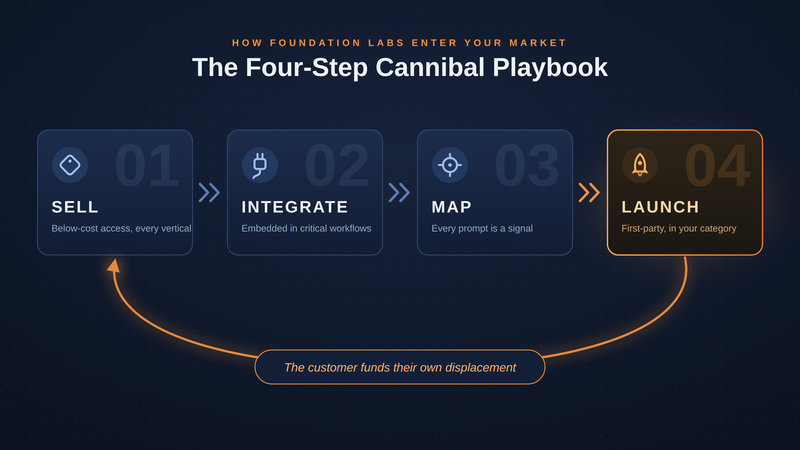
We've already seen this play run. OpenAI launched custom GPTs and tools that compete directly with the businesses built on its API. Google's Gemini integrations are eating into categories that Google Workspace partners spent years developing. The road from trusted infrastructure to direct competitor gets shorter with every product cycle.
The mistake isn't using these platforms. The mistake is using them without understanding that your data, your edge cases, and your expertise are the actual product being built.
This isn't villainous. It's rational. Anyone sitting on that much data about how businesses work, and that clear a view of which industries have pricing power, would do the same thing. I would. You probably would too.
The labs aren't betraying you. They're just playing a different game than you think you're playing.
You aren't their customer. You're their product research.
Getting angry about it accomplishes nothing. The useful move is deciding what you build once you know how the game works.
This isn't a thought experiment. The pattern has already played out several times, across several categories, with companies that had every reason to believe they were safe.
Design. Figma partnered with Anthropic and built AI features on Claude. Anthropic's product chief joined Figma's board, a partnership so close it looked like protection. Then the board seat ended. Then came Claude Design. That sequence isn't a coincidence. It's a playbook.
Legal & Biotech. Harvey built a serious legal AI business on Claude. Benchling built a biotech research platform on the same foundation. Both spent years solving the hard problems: regulation, workflow integration, industry-specific edge cases. Then Anthropic launched Claude for Legal and Claude Science. The labs didn't need to build that expertise from scratch. Their partners had already done it, workflow by workflow, use case by use case.
Customer Support. Intercom used OpenAI's Realtime API to build Fin Voice, a sophisticated support agent. OpenAI then launched Presence, a voice-and-chat support product, into the same market. Every edge case Intercom worked through, every conversation their users had, ran through OpenAI's infrastructure before OpenAI decided to compete there.
Big Tech. If you think size and money make you safe, look at Microsoft. Thirteen billion dollars invested in OpenAI. Deep board involvement. And OpenAI is reportedly building a jobs platform to challenge LinkedIn and a code repository to challenge GitHub. Both Microsoft properties. The biggest investor in the space isn't safe from this either.
The partnership isn't the problem. The assumption of safety inside the partnership is.
Each case follows the same arc. A company builds something real on a foundation it doesn't control. The foundation provider watches, learns, and eventually decides the category is worth owning. By then, the builder has already done the hardest work: proving the market, mapping the workflows, finding out what breaks.
The risk isn't that AI labs are malicious. It's that they're rational. And once someone else has proven a category works, the rational move is to enter it.
This isn't just a software problem. The Figma and Harvey stories get told as warnings for tech companies because the players are tech companies. But the mechanism doesn't care what industry you're in.
Any organization feeding its processes, expertise, or strategy into a foundation model is doing the same thing, at a smaller scale, with less awareness, and almost certainly without a legal team that has thought through what's at stake.
The Blueprint Problem: Building your core operations inside someone else's model is like handing your blueprints to a contractor who is planning to buy your building. The work gets done. The blueprints don't come back.

The contractor analogy works because the trade is so uneven. You get the renovation. They get a detailed map of your structure, your load-bearing walls, your weak points. Everything they need to build a better version without you in it.
Take a regional bank using an AI model to speed up credit decisions. On the surface, that's a productivity win: faster approvals, less manual review, more consistency. What's actually happening is that decades of institutional knowledge is being handed to a system that will eventually offer a competing credit product. How that bank thinks about risk in its markets. Which signals it trusts. Where it draws lines its competitors don't. The bank automated away its own edge.
And the imbalance grows in a way no ROI calculation captures. The lab sees signals from thousands of companies at once. A logistics company's supply chain planning, an insurer's underwriting rules, a manufacturer's pricing logic. Each one is a data point. Together, they add up to an education in how the hardest problems in every industry actually work.
Any single company sees only its own deployment. The lab sees the pattern across all of them.
That advantage doesn't stand still. It grows every quarter, with every enterprise contract, with every workflow a company is proud of having automated. The labs are collecting this either way. The open question is whether your organization has thought seriously about what it's giving up.
Avoiding AI isn't a strategy. It's a slow exit. The real question isn't whether to use it, but how to use it without handing your advantage to the vendor selling you the tool.
There's a distinction worth being precise about:
-Accelerator use means AI speeds up work your team already knows how to do.
-Infrastructure use means your business logic and judgment move inside the model itself.
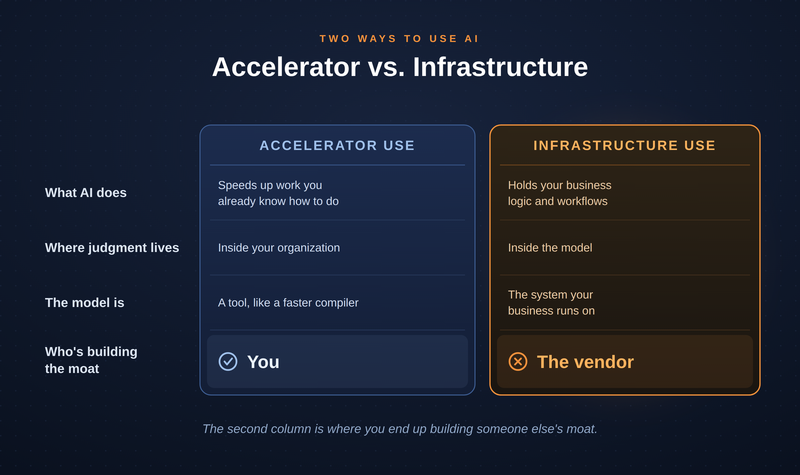
The second column is where companies end up building someone else's moat while believing they're building their own.
Before your next integration decision, your leadership team should be able to answer three questions:
The companies that win with AI won't be the ones who adopted it fastest. They'll be the ones who used it without becoming dependent on it.
Three guardrails, less about compliance than about common sense:
None of this is complicated. It's just easy to skip when you're moving fast and the tool is working.
The companies that will get the most lasting value from AI are the ones that use it to speed up what they uniquely know, not the ones that hand what they uniquely know to the model and call it transformation. That sounds simple. It isn't. It requires an honest answer to what you actually own: your data, the customer relationships you spent years building, the judgment your team earned by operating in a specific market. Most organizations have never had to spell that out. AI is forcing the question.
The tension is that this discipline is hardest to keep at exactly the moment AI makes it easiest to drop. The tools are fast. The outputs are impressive. The demos are exciting. And the risk, that you're training your future competitors or giving away the thing that made you hard to compete with, stays invisible until it isn't. By the time it shows up in your numbers, the leverage has already changed hands.
So here's the question worth asking:
How is your organization using AI to build your own long-term moat, rather than unknowingly building someone else's next product?
The labs are playing a long game. The question is whether you are.
The advantage gap is the growing distance between companies that adopt AI early and those that don't. It doesn't come from any single task. Faster cycles mean more learning over time: a competitor who ships 3x faster runs more experiments, learns from more mistakes, and pulls further ahead with every sprint. Over 12 months, that's not a speed difference. It's a moat built from repetition you weren't part of.
AI labs are not neutral infrastructure. They are active players in their customers' markets, studying how their models get used and building competing products with an advantage no startup can match. Every API call you make teaches the lab about your market, your users, and the gaps in your product. The pattern has already played out in legal (Harvey), design (Figma), and customer support (Intercom): the lab watches, learns, and eventually decides the category is worth owning.
The Four-Step Cannibal Playbook is the sequence AI labs use to replace the companies that funded their market research: Sell, Integrate, Map, Launch. They offer below-cost access to get built into important workflows, learn the expertise and edge cases through usage data, then release their own product that competes directly with the customer who proved the category works. It's not a conspiracy. It's sitting in their investor decks and product announcements. You just have to read it the way a competitor would.
Before any integration decision, your leadership team needs to answer three questions. What knowledge are we handing over? What does it cost to leave if this vendor enters our category? And what are we building that they can't copy? The line that matters is between using AI as an accelerator, speeding up work you already know how to do, versus using it as infrastructure, where your business logic and judgment live inside someone else's model. The first builds your moat. The second builds theirs.
Avoiding AI isn't safe. It's a slow exit. The pressure from AI-native companies running at half the headcount and twice the speed is already reshaping most markets. The answer isn't staying out. It's being precise: use AI to speed up what you uniquely know, while keeping your most valuable knowledge in systems you control. The companies that win will be the ones who used AI without becoming dependent on it, not the ones who opted out.
The mechanism doesn't care what industry you're in. Any organization feeding its processes and strategy into a foundation model faces the same dynamic, usually with less awareness and no legal team that has thought through what's at stake. A regional bank automating credit decisions is handing decades of risk judgment to a system that will eventually offer a competing credit product. The Figma and Harvey cases get the press because the players are tech companies, but the blueprint problem applies anywhere real expertise meets a foundation model.
When AI is an accelerator, it speeds up work while judgment stays inside your organization. The model is a tool, like a faster compiler. When AI becomes infrastructure, your business logic and workflows live inside the model, and the vendor is the one gaining the advantage. Most companies make this shift gradually and without noticing, at exactly the moments when the tool is working well and the risk is hardest to see. By the time it shows up in your numbers, the leverage has already changed hands.
Three guardrails, less about compliance than about common sense. Keep your most valuable knowledge in systems you control, and give the model structured inputs rather than open access to the thinking that took a decade to develop. Put a layer between your business logic and the model API, so the model sees clean data instead of your core rules. And treat AI vendors like any partner with a conflict of interest: get clear contract terms on data usage and write down your exit plan before you need it. None of this is complicated. It's just easy to skip when you're moving fast and the outputs are impressive.
